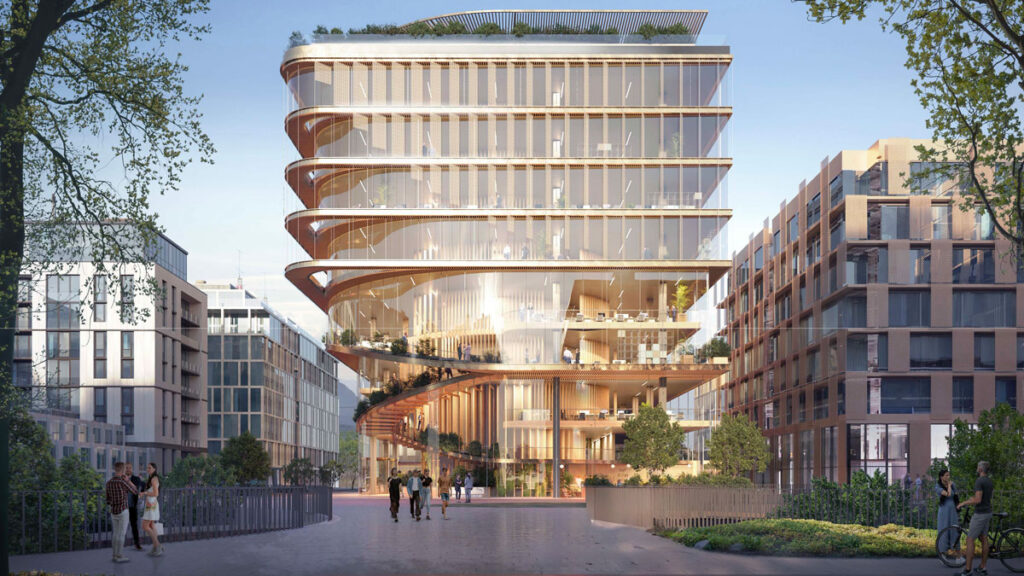
On the future Place des Bassins in the Square Mile in Belval the iconic Kyklos building will soon be erected, full of voluptuous curves. Through interviews, documents and models, our quest is to understand the principles of sustainability, energy design and distinctive architecture that have gone into the design of this building, soon to be proudly erected on lot 48. “On this, the very last plot to be developed at Belval, Kyklos will be the focal point for the entire pedestrian zone, and we wanted a strong architectural identity,” explain Zahira Malyani, project manager urban planner, and Jean-Xavier Foidart, development manager.

Once upon a time there was lot 48
At the very beginning, there was a lot. On the master plans for the area, this was “lot 48”. A number like any other in the short list of lots still available at Belval – but it was soon to become the inspiration for a new architectural vision. Its central position in the district prompted AGORA to come up with “iconic architecture” when it drew up the masterplan, which could be a “technological showcase for sustainability”.

These are the words of Jean-Xavier Foidart. In his office at AGORA, avenue du Rock’n’roll in Belval, he unfolds the brochure he sent out to developers a few months ago, presenting this major project. Here we can already see the main principles behind the final architectural project designed by HYP Architects and UNstudio, the firms that won the international competition run by AGORA and the chosen developer, Atenor, in conjunction with ARHS DEVELOPMENTS ( who will use the building as their offices).
“Kyklos is an opportunity to design iconic architecture that defies convention. This distinctive look is designed to embody the boldness and innovative character of its new owner. Kyklos will also be showcasing the latest trends in sustainable development and healthy construction, because the climate emergency requires nothing less.”
AGORA has included in its specifications a requirement for the Kyklos building to “respect the principles of the new European green taxonomy,” adds Zahira Malyani.
What does that mean? Taxonomy is to some extent the European Union’s environmental compass. To explain the objectives accurately, AGORA’s planner opens the Official Journal of the European Union1 of 26 June 2020 and reads out extracts from the regulation setting out the desired measures.

“The environmental objectives that should be covered by the regulation [incluent] include climate change mitigation; adaptation to climate change; the transition to a circular economy and the prevention and control of pollution. Economic activity that pursues the environmental objective of climate change mitigation should contribute substantially to the stabilization of greenhouse gas emissions by avoiding or reducing these emissions.”
– Page 17 of the Official Journal of the European Union from June 26, 2020 1
And Kyklos also respects the principles of territorial development of the “new European Bauhaus 2″2 , which advocate on the one hand “sustainability, from climate objectives to circularity and biodiversity”, and, on the other hand, “aesthetics, i.e. quality of experience and style, over and above functionality”, as well as “inclusion, including accessibility and affordability”.
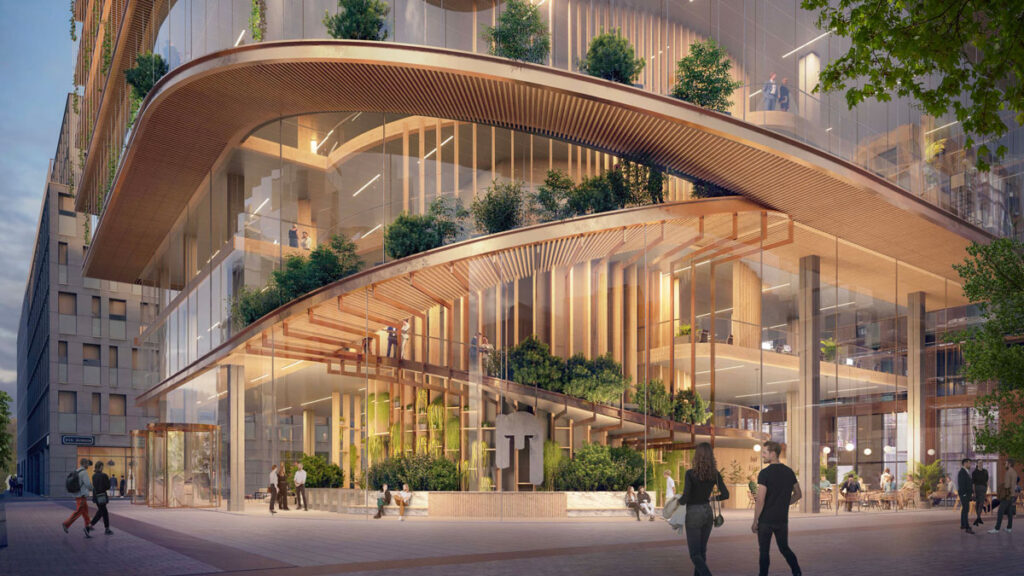
A sublime curvilinear design
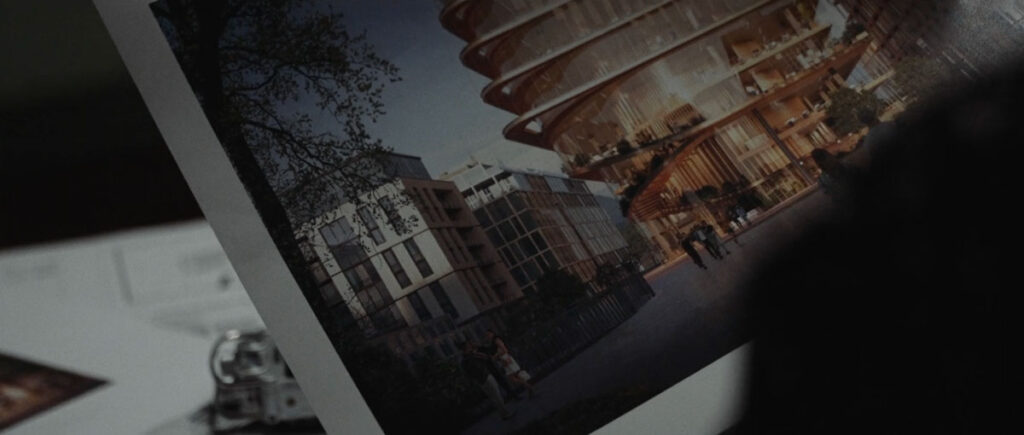
On Jean-Xavier’s desk, we see 3D models of the Kyklos project. The eight-storey building project is multi-dimensional, but what strikes us first is the rounded aesthetic lines. Encased in wood and glass, the Kyklos building boasts a curvilinear geometry that echoes the infinite loops of the neighbouring Place des Bassins. Zahira Malyani is full of praise for this unique design.

“As soon as we saw the first images, we thought it was magnificent. It had an instant wow effect! The ground floor and the first three storeys form a glazed, rounded core on the south-east corner. The glittering windows also reveal wooden staircases with slightly curved structures. Above these floors, we have four more traditional, linear floors. On the top floor, there is a large south-facing terrace. A large part of this floor will be planted out. You’ll get to enjoy some wonderful views of Belval! »
– Zahira Malyani, Urban planner project manager, AGORA
At the end of an international architectural competition requiring architects to show tremendous creative freedom in designing a landmark building, the HYP Architects and UNstudio teams came up with a bold proposal that was a winner with the selection committee formed of representatives from the three partner companies, Atenor, ARHS and AGORA.

In an unprecedented move, before deliberating, the committee was assisted by a panel of experts who assessed each project. “The committee included an expert in architecture, an expert in town planning, an expert in sustainable development, an expert in BIM, an expert in building economics, an expert from the Sanem local authority and an expert from ArcelorMittal,” explains Jean-Xavier Foidart.
A total of 29 applications were received for the competition, but only three were shortlisted to guarantee optimum involvement of the architects in the final stages of the process.
A sustainable construction, circularity and an energy-efficient design
In the future Kyklos building, aesthetics will naturally go hand in hand with eco-friendliness. This is thanks in part to a clever energy design: the architectural project will be fitted with solar panels to generate electricity, and efficient insulation to reduce energy consumption. It is also the product of a thoughtful approach to interior design for long-term sustainability. Above all, it was designed based on an in-depth analysis of the building facades to optimise sunlight and minimise energy consumption. To explain everything, Jean-Xavier Foidart turns on his computer screen and zooms in on the BIM models.
“Our sunlight and shade studies led us to treat each facade differently. The aim is, for example, to avoid too much sun in summer, which could lead to excessive use of air conditioning, while maximising the amount of natural light and heat in winter, or to adjust the amount of shade for optimum lighting levels depending on whether the building faces north or south. The rings you see on one side of the building have been carefully calculated in terms of width, angle and positioning to provide maximum shading all year round. Vertical shading was also factored in, because of the sun’s trajectory during the day! »
– Jean-Xavier Foidart, development manager, AGORA
It goes without saying that, throughout the construction of the building, circularity and the choice of materials that reduce its carbon footprint will be prioritised. “The construction will have a reduced carbon footprint thanks to the use of decarbonised and recycled steel and the prioritisation of short supply chains to minimise transport-related emissions,” explains Zahira Malyani. There are also plans to use green energy in steel production.”

And to coordinate all this, the BIM process for effective collaboration was implemented from the earliest stages of the project. Already, the complete BIM model of the site is teeming with data. This is necessary, needless to say, given the unprecedented degree of co-development between AGORA and its various partners. At each stage of the project, all decisions were taken in a perfectly joint manner.
The Kyklos building project is characterised by an original architectural approach, sustainability and the unprecedented nature of the tripartite co-development process. This iconic structure will be the pride of Belval on the Square Mile.
1 Journal of the European Union